
The steel grade is the most frequently skipped line in a mold quotation, and the one that decides how long the tool lasts. Two suppliers can quote the same cavity count and the same tonnage and still be selling you molds that differ by a factor of five in service life — because one used P20 and the other used hardened H13. This is what the grades actually mean, and how to choose between them without overpaying.
The Line Nobody Reads
Tooling quotations usually list the cavity count, the mold base size, the hot runner brand if there is one, and a delivery date. The cavity steel is often reduced to a phrase like "718 or equivalent", or omitted entirely. That single omission is where most of the value in a mold is hidden.
Three things follow from the steel choice, and none of them show up on the day the mold arrives:
- How many shots it survives. A pre-hardened steel at 30 HRC and a hardened steel at 50 HRC are not separated by 20 points of hardness — they are separated by roughly an order of magnitude in wear life under an abrasive resin.
- Whether the surface can be what you specified. A mirror polish, a fine texture and a matte grain each require a different level of steel cleanliness. Some grades physically cannot reach a given finish, no matter how long the polisher works.
- Whether the mold fights the resin. PVC, flame-retardant compounds and several engineering resins release acids that corrode ordinary tool steel. A mold that rusts between shifts produces stained parts and needs constant re-polishing.
None of this is expensive to get right at the design stage. It is very expensive to get wrong after the steel is cut, because changing grade means new inserts, new heat treatment and a new validation cycle. The wider cost structure is covered in what drives injection mold cost; this article is about the one decision that sits inside it.
Four Grades Cover Most Molds
There are dozens of tool steels, and a shop that advertises fifty grades is telling you something about its purchasing rather than about your project. In practice, four families cover the overwhelming majority of injection molds. Here they are, with the range of numbers you should expect to see in a real quotation.
| Grade | Hardness as supplied | Polish | Corrosion | Typical shots | Cost vs P20 | Where it belongs |
|---|---|---|---|---|---|---|
| P20 / 1.2311 | 28–32 HRC, pre-hardened | Good | Poor | 100k–500k | Baseline | General parts, short and medium runs |
| 718H / 1.2738 | 33–36 HRC, pre-hardened | Very good | Poor | 500k–1M | +10–20% | Large parts, textured faces, longer runs |
| 1.2316 | 30–34 HRC, pre-hardened | Very good | Good | 500k–1M | +25–45% | PVC, flame-retardant and acid-releasing resins |
| S136 / 1.2083 | ~30 HRC pre-hard; 50–52 HRC hardened | Excellent | Very good | 1M+ | +30–60% | Optical, transparent, medical, corrosive melts |
| NAK80 | 38–41 HRC, pre-hardened | Excellent | Moderate | 500k–1M | +30–50% | Mirror finishes without a heat treatment step |
| H13 / 1.2344 | ~220 HB annealed; 48–52 HRC hardened | Good | Moderate | 1M–5M+ | +40–70% | Glass-filled and abrasive resins, high volume |
| 7075 aluminum | ~150 HB | Fair | Poor | 1k–10k | −40–60% | Bridge tools, prototypes, design validation |
One caveat before reading the numbers as a guarantee: shot life depends on the resin, the part geometry, the cooling, the maintenance interval and how the mold is handled. The figures above are the ranges a tool designer would use for planning, not a warranty.
P20 / 1.2311 — the default
Pre-hardened to roughly 28–32 HRC, supplied ready to machine, and the cheapest sensible option for a cavity. It machines well, takes a good polish and is forgiving of the small dimensional corrections that every new tool needs. For a consumer product with a two or three year life and no abrasive filler, P20 is not a compromise — it is the correct answer, and paying more buys life the program will never consume.
Its limits are equally clear: it is not corrosion resistant, it cannot hold a true mirror finish on a large surface, and it wears visibly under glass-filled resin.
718H / 1.2738 — the workhorse
718H is a modified P20 with higher hardenability and better homogeneity through thick sections, delivered at about 33–36 HRC. Two practical differences matter. It polishes to a higher standard, which is why it dominates large visible parts such as appliance housings, TV backs and automotive interior trim. And it holds hardness deeper into a big block, so a thick cavity plate does not end up softer in the middle than at the surface.
The cost premium over P20 is modest — commonly in the region of 10–20% on the cavity steel — which is why it is the most common upgrade in a well-specified quotation. If a supplier quotes 718H as standard, that is a reasonable sign.
S136 / 1.2083 and 1.2316 — stainless, for two different reasons
These are often treated as one category, and they are not.
- S136 (1.2083) is a 13.5% chromium stainless that can be supplied pre-hardened around 30 HRC or hardened to 50–52 HRC. Its distinguishing property is polishability: it can be taken to an optical finish, which is why it is the default for lenses, light guides, transparent housings and medical parts. It is also corrosion resistant.
- 1.2316 is a pre-hardened stainless at roughly 30–34 HRC. It is chosen primarily for corrosion resistance rather than for the ultimate polish, and it is the workhorse for PVC and for halogenated flame-retardant resins.
The mistake is using ordinary tool steel for PVC because the quotation was cheaper. Hydrogen chloride from the melt attacks carbon steel quickly, and the visible symptom — rust blooming on a polished cavity between shifts — is followed by pitting that no amount of polishing removes.
H13 / 1.2344 — when abrasion decides
H13 is a hot-work steel supplied annealed and then hardened and tempered to about 48–52 HRC after machining. It is the answer when the resin is abrasive or the volume is large: 20–30% glass-filled nylon will erode a soft gate in a matter of months, and once the gate erodes, wall thickness and flash both drift.
The trade-off is a real one. Hardened steel cannot be milled after heat treatment, so late changes are made by EDM, wire cutting or grinding — all slower and more expensive than a cut on a milling machine. Heat treatment also introduces distortion that has to be planned for with grinding allowance. A supplier who quotes H13 without mentioning any of this has not thought it through.
A useful question: ask which grade they would use if the tool were their own, and why. The answer reveals whether the quotation was designed for your part or priced for the competition. A supplier who says "718H, because at your volume P20 will need re-polishing at year three and H13 is more than you need" is giving you engineering. One who says "P20 is standard, it’s fine" is giving you a price.
The Exceptions Worth Knowing
A few materials appear often enough to be worth naming, usually because they solve a problem that the four main grades cannot.
- NAK80 — pre-hardened at about 38–41 HRC with excellent polishability. Its value is that it gives near-mirror results without a hardening step, so there is no distortion and no post-heat-treatment grinding. Common on optical parts and on tools where the schedule cannot absorb a heat treatment cycle.
- Aluminum 7075 — for bridge tools and prototypes. Fast to machine, cheap, and good enough for a few thousand parts to validate a design. Not a production material; it dents, wears at the gate and cannot be repaired the way steel can.
- Beryllium copper inserts — not for the cavity face but for hot spots. Its thermal conductivity draws heat out of a thick section, shortening the cycle and reducing sink. Usually placed as a small insert at a boss or a gate.
- Free-machining grades such as 1.2312 — the one to be careful with. Added sulfur makes them cut fast, and they are sometimes substituted without asking because they save machining hours. They also cannot be polished to a high finish, and the sulfur can affect weldability and texturing. On a cosmetic part this substitution is a defect waiting to happen.
- Coatings — hard chrome, TiN, DLC and nitriding all extend life on an existing tool, and are a legitimate way to rescue a mold that is wearing faster than expected. They are not a substitute for choosing the right base steel, because a coating on a soft substrate fails by punching through rather than by gradual wear.
Which Part of the Mold Gets Which Steel
"What steel is the mold?" is the wrong question, because a mold is not made of one steel. The cavity is the part that matters, but several other components carry as much load or wear.
| Mold component | Common choice | Why |
|---|---|---|
| Cavity and core inserts | P20, 718H, S136 or H13 — the decision this article is about | These form the part, take the wear and carry the surface finish |
| Mold base plates | S50C or 1.1730 carbon steel | Structural only; they never touch the melt at temperature, so paying for tool steel here is wasted money |
| Slides and lifters | Hardened steel, often H13 or 1.2344, 48 HRC and up | They slide under load every cycle; a soft slide wears oval and starts flashing within months |
| Gate inserts | Hardened steel or beryllium copper | The highest shear and the fastest wear in the tool; beryllium copper also helps freeze the gate faster |
| Ejector pins and sleeves | Through-hardened or nitrided standard parts | Cheap, standard, and replaced rather than repaired |
| Hot runner manifold | Bought-in system, not shop steel | Designed and heat-treated by the supplier of the system — see the hot runner comparison |
| Corrosive-resin tooling | 1.2316 or S136 throughout the melt path | One carbon-steel plate in the flow path is enough to start a rust cycle that stains every part |
The practical consequence: a quotation that names one grade is incomplete. Ask for the cavity, the core, the slides and the gate inserts separately. Where the answers differ sensibly — hardened slides in an otherwise 718H tool — you are usually looking at a supplier who has built this kind of mold before.
Not sure which grade your part needs?
Send us the 3D model, the resin grade and your expected total volume. We will tell you which cavity and core steel we would use, where we would harden, and what the alternative costs — then quote it with the grades written out line by line, so you can compare offers on equal terms.
Match the Steel to the Resin
Volume sets the hardness you need. The resin sets whether the steel will survive at all. This table is the shortcut most tool designers carry in their heads.
| Resin | Main attack on steel | Recommendation |
|---|---|---|
| PP, PE, PS, ABS | Almost none | P20 is enough at moderate volume; 718H if the run is long |
| PC, PC/ABS | High melt temperature, some acidity | 718H for most work; 1.2316 or S136 where clarity or corrosion matters |
| PVC, CPVC | Releases hydrogen chloride, which attacks steel fast | Stainless through the whole flow path — 1.2316 or S136. Carbon steel will rust between shifts |
| POM | Formaldehyde release, plus a narrow process window | Stainless or well-maintained 718H; avoid stagnant hot-runner drops |
| Halogenated flame-retardant grades | Acidic breakdown products | 1.2316 or S136, plus regular cleaning of water lines and vents |
| PA with 20–30% glass fiber | Abrasion — glass is harder than most tool steel | H13 at 48–52 HRC, or hardened inserts at the gate; soft steel is polished away in months |
| Mineral-filled and highly pigmented compounds | Slow erosion of gates and flow paths | 718H minimum; hardened gate inserts are usually cheaper than a rebuild |
| Transparent PC, PMMA, PS | Nothing chemical, but every inclusion shows | S136 or NAK80 for a true mirror; see the polishability section |
Two notes on reading it. First, the attack is often not the polymer itself but an additive: flame retardants, release agents and residual catalyst in regrind all contribute. Second, corrosion is a maintenance issue as much as a materials one — water lines left wet over a shutdown will rust any carbon steel mold from the inside, which is why drying the circuits before storage is part of a proper maintenance routine.
Pre-Hardened or Hardened Later
This is the decision that actually changes the tooling schedule, and it is usually buried in a single word in the quotation.
Pre-hardened steels — P20, 718H, NAK80, 1.2316 — arrive at their working hardness. Every machining operation happens at final hardness, dimensions are final when the last cut is made, and a design change can be accommodated by cutting more steel. The mold is finished when the machining is finished.
Hardened-after-machining steels — H13 and S136 in their hardened condition — are rough machined in the annealed state, heat treated, and then finished. That introduces three consequences:
- Distortion. Quenching moves the part, and the movement is not uniform. Allowance has to be left on every surface that will be ground or wire-cut afterwards, and complex cavities with thin ribs move more than solid blocks.
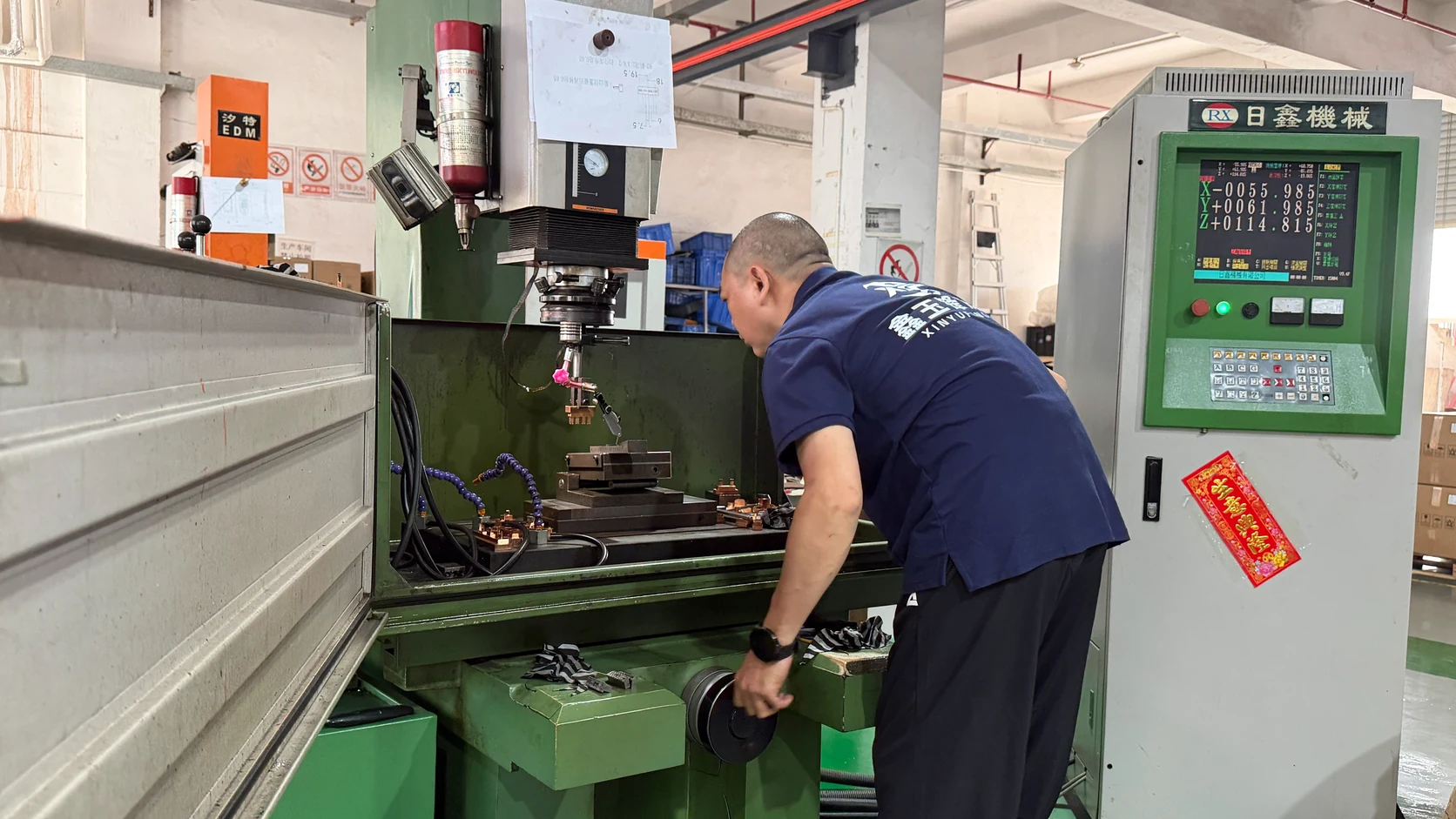
- Limited finishing methods. After hardening, the only options are grinding, EDM, wire cutting and polishing. A pocket that needs a change is a wire EDM job, not a milling job.
- Risk concentration. A heat treatment crack discovered after hardening means a new insert, and the schedule absorbs the whole cycle again. This is why hardened tools are specified with more generous section thickness and better fillets than a pre-hardened equivalent.
None of that argues against hardening — for a five-million-shot tool there is no alternative. It argues for deciding early, and for expecting the requirement to appear in the quotation as a separate heat treatment line with a named hardness and a named process.
Polishability and the Sulfur Trap
Polishability is not one property but the result of three: hardness, cleanliness and microstructure. Two steels at the same hardness can behave completely differently under a polisher’s stones.
- Inclusions are the enemy. Non-metallic inclusions — sulfides, oxides, and in badly made steel porosity — open up as pits during polishing. On a matte texture they are invisible. On a mirror surface they are the defect that fails the first article inspection.
- Homogeneity matters on thick sections. Segregation in a large block produces bands of different hardness, and a polisher chasing a band will dish the surface. This is the practical reason 718H outperforms ordinary P20 on big cavities.
- Sulfur is added on purpose in free-machining grades, precisely to break chips. Those same sulfide stringers are what prevent a mirror finish. If the part is cosmetic, the grade must be specified explicitly rather than left to the shop’s convenience.
The same logic applies to texture. An etch responds to the steel’s structure, so a coarse or banded microstructure produces an uneven grain that no amount of etching control can fix. If a textured finish is part of the design, the steel choice and the texture specification have to be made together — which is the same principle that makes mold design and mold building a single conversation rather than two.
What It Costs, What It Buys
The premium for a better grade sounds large as a percentage and looks small as an absolute number, which is why it is so often negotiated away. Set it against what a rebuild costs.
| Situation | Cheaper option | What it actually costs later |
|---|---|---|
| 200k shots, simple part, no cosmetics | P20 | Nothing. This is the case P20 was designed for, and upgrading buys life you will never use |
| 800k shots, textured visible part | P20 saved at purchase | Texture wears unevenly, the polish line disappears, and the tool needs re-texturing or replacement within a few years |
| PVC part, carbon steel mold | Saved 25–45% on the cavity steel | Rust staining, pitting of the polished faces, and a mold that has to be pulled and re-polished repeatedly |
| 30% glass-filled PA, soft cavity | Saved 40–70% | Gate erosion within months; wall thickness drifts, flash appears, and the gate inserts have to be cut out and replaced |
| Transparent lens, free-machining steel | Saved on machining time | The part can never reach optical clarity, because the steel cannot take a mirror polish at all |
The pattern is consistent: the upgrade costs a fraction of the tool, and the failure it prevents costs a replacement insert, a re-validation and a production interruption. The exception is the first row — genuinely short programs, where the cheap grade is not a shortcut but the right engineering answer.
It is also worth remembering that the steel is only one input to part cost. Cycle time, cavity count and the runner system usually move the piece price more than the grade does, which is why the runner decision deserves its own analysis. If tooling life and part cost are both on the table, the classification of the mold — its structure, not its steel — sets the ceiling on both.
How to Write It Into an Order
A short specification, written once, prevents most of the arguments that follow. Six lines are enough:
- Grade, per component. Cavity, core, slides, gate inserts and mold base, listed separately, with the standard number (1.2311, 1.2738, 1.2083, 1.2344) rather than only a trade name.
- Hardness, as a range. "48–52 HRC" rather than "hardened". Ask where it is measured.
- Heat treatment process, if any — vacuum hardening, tempering cycles, and who performs it.
- Surface finish for the cavity, in the standard your industry uses, plus the texture specification if there is one.
- Steel certificates with heat numbers, delivered with the handover package.
- Substitution clause. No grade change without written agreement — the single most useful line in the document, because "equivalent" is where free-machining steel quietly replaces a polishable one.
That last point is worth repeating in a different form: the risk is not usually a supplier choosing a bad steel on purpose. It is a substitution made for schedule or cost that nobody flags, discovered two years later when the texture has worn unevenly. The supplier vetting checklist covers how to establish that a shop will actually tell you; this article covers what to ask about. Between them, the two decisions — who builds it and what it is built from — account for most of the variation in outcomes.
For the material side of the same question — choosing the resin rather than the steel — see plastic material selection and engineering support. And for how the steel, the wall thickness and the cooling interact during the cycle, how plastic injection molding works covers the process from the melt’s point of view.
Frequently Asked Questions
Is 718H better than P20 for every mold?
No. It is better for large cavities, textured faces and runs beyond a few hundred thousand shots, and it costs 10–20% more on the cavity steel. For a small part with a modest volume and no cosmetic requirement, P20 is the correct choice and the premium buys life the program will never use. The useful test is total expected shots and whether the surface is cosmetic — if both are modest, the cheaper grade is not a compromise.
Can I use P20 for a PVC part to save money?
Not sensibly. PVC releases hydrogen chloride during processing, and carbon steel in the flow path corrodes quickly — the first symptom is rust blooming on polished faces between shifts, followed by pitting that cannot be polished out. The specification should be a stainless grade such as 1.2316 through the whole melt path, including the runner and the gate, not just the cavity face.
How many shots will a mold last?
It depends more on the resin and the maintenance than on a single number, but the planning ranges are useful. Pre-hardened steel at 28–32 HRC is typically planned for 100,000–500,000 shots; 718H for around half a million to a million; hardened H13 at 48–52 HRC for a million and well beyond, with proper servicing. Abrasive glass-filled resins shorten all of these substantially, and a well-maintained tool outlasts a neglected one of better steel.
What does "or equivalent" mean in a quotation?
In practice, it means the supplier may substitute a different grade without further discussion — and the usual substitute is a free-machining steel that saves machining hours but cannot be polished to a high finish. If the part is cosmetic, or if the texture matters, remove the phrase and require written agreement for any change. A grade named as a standard number, with a hardness range and a certificate, leaves nothing to interpret.
Why does hardened steel cost more than the grade premium suggests?
Because the premium is not only the steel. Hardening adds a heat treatment step, requires grinding and wire EDM allowance on the surfaces that have to be finished afterwards, exposes the project to distortion and to a small but real risk of cracking, and makes late design changes much slower. On a complex cavity, the process cost can exceed the material difference. That is also why a hardened tool should be designed with more generous sections and fillets from the start.
Do coatings replace the need for a better steel?
No, though they help. A hard coating on a soft substrate fails by punching through at the gate and on high-load edges, because the steel underneath cannot support the film. Coatings are most useful on an already-correct grade when a specific wear or release problem appears, or to extend the life of an existing tool while a replacement is planned.